


Theographic's Impact: The Fruit of the Branches
And he shall be like a tree planted by the rivers of water, that bringeth forth his fruit in his season; his leaf also shall not wither; and whatsoever he doeth shall prosper.
Imagine being an apple tree. Your purpose in life is to bear good fruit: stay rooted, grow, and produce the sweetest, ripest apples you can. You can’t take them to the marketplace, bake them into a pie, or plant their seeds in another orchard. You can only offer them freely to those who desire what you’ve produced. They may eat them, sell them, or let them go to waste. Once the fruit leaves your branches, its outcome is no longer yours to control.
I think of my calling as a ministry of data, and most days it looks a lot like tending a tree. I gather the information, share it widely, and rarely see where or how it ends up being used. Recently I stumbled onto a new, impressive website built with those resources. Then I heard of another, and another. I finally decided to look for similar projects and list them in this post for others to explore.
These discoveries have touched me more than I expected. People have made wonderful things with records I have collected, cleansed, and organized, often without our ever meeting or exchanging a message. It’s hard to take it all in, in a good way.
I’ve imagined apps and sites like these for years, planned to build them, and felt frustrated by how little one person like me can accomplish alone. Yet here is that vision fulfilled beyond the things I had imagined. The things others have built are better, richer, and more comprehensive than what I planned to make by myself.
While I’ve felt limited by circumstances and normal human constraints, I now see clearly that my limits are not God’s limits. He can work through anyone who’s willing, and so many people are giving their time and talents to help us understand Scripture through available technologies.
While I’ve felt limited by circumstances and normal human constraints, I now see clearly that my limits are not God’s limits. He can work through anyone who’s willing, and so many people are giving their time and talents to help us understand Scripture through available technologies.
A tree can’t bake a pie, but I get to see and taste what others have made with the fruit in deeply satisfying ways. To the builders who have used my data: thank you for the care and imagination you’ve brought to this work. I’m grateful to you, and to God, for helping this vision come to life.
If you’re among those creators, please say hello. I’d love to meet you and hear more about what you’re working on.
What We’re Building Together
Theographic is one project within a wider community making Bible data openly available. Leaders in this area include OpenBible.info, STEPBible at Tyndale House, BibleAquifer, and the Free Use Bible API.
AO Lab deserves special mention. It is the team behind both the Free Use Bible API and Seed Bible. This organization is gathering the community’s open work into one free, shared place that anyone can build on. That is what one body and one spirit should look like: not a single project at the center, but many hands at the same table.
I also recognize that good gifts come from many places, even beyond the church. Scholars building Pleiades, a community-built gazetteer of ancient places, have mapped the ancient world with remarkable care, and where Bible places clearly match theirs, we gratefully rely on their work to strengthen Theographic’s ancient geography files.
Notable Projects
The sites below carry many of the same themes: making connections visible, bringing context alongside the text, and helping readers explore the biblical story. Many combine Theographic data with resources from elsewhere in this community.
Seed Bible
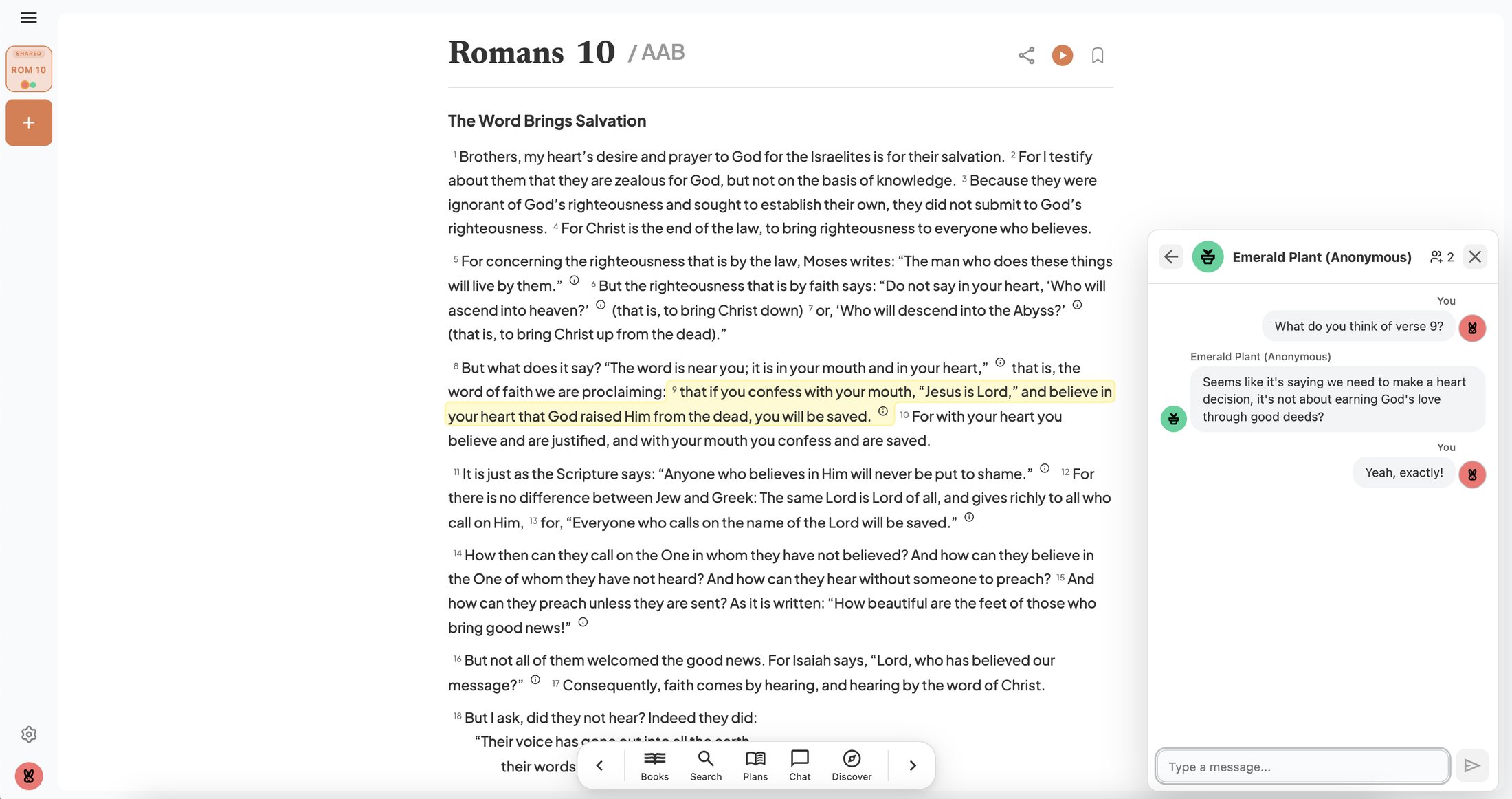
AO Lab’s Seed Bible is an extensible study environment whose platform brings linked people, places, and events into contextual cards and maps using Theographic data. The approach puts reference information alongside the text rather than leaving readers to assemble the connections themselves.
History Globe
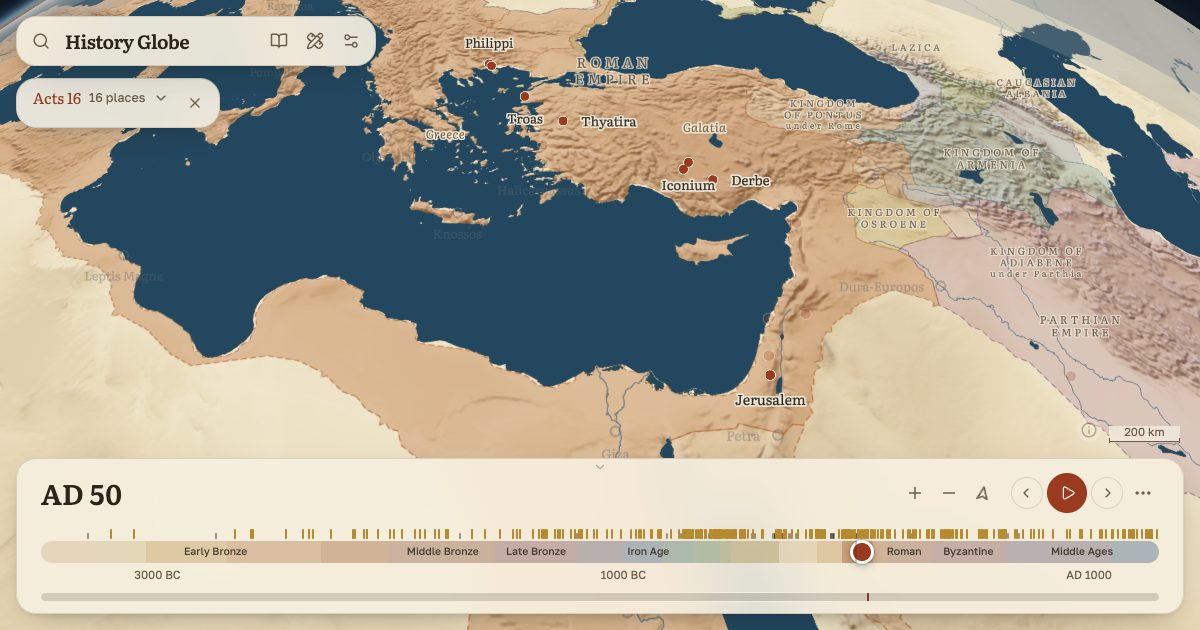
History Globe explores biblical history on an interactive globe which morphs the map according to the timeline while connecting places, people, tours, and historical context. It brings a geographic perspective to the same interest in helping readers see how each story fits together.
Bible Atlas
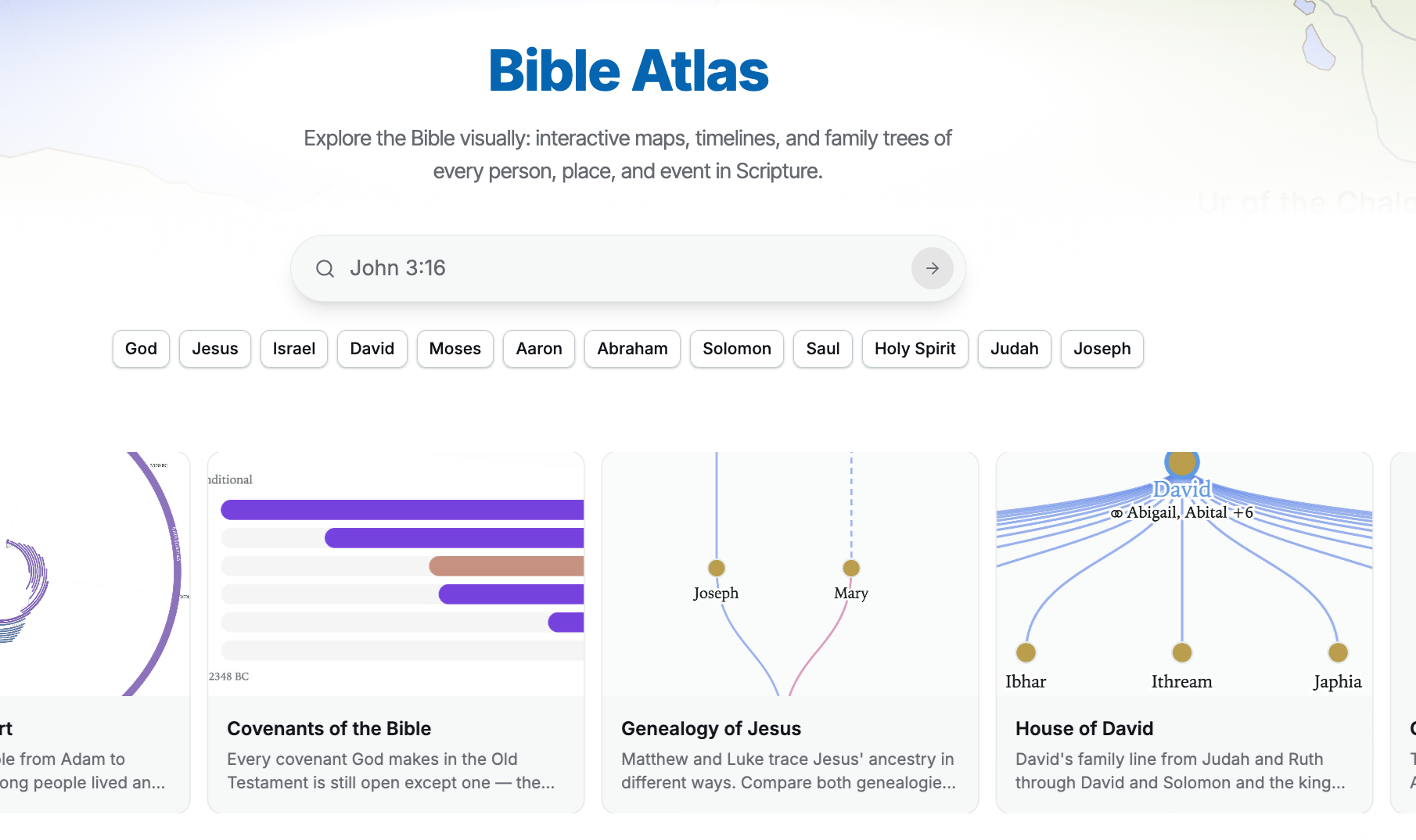
Bible Atlas gathers maps, family relationships, timelines, and networks into a visual reference site. The variety of views offers several entry points into the same connected material, whether you begin with a place, a person, or an event. It combines Theographic’s people, places, events, and family and geographic relationships with cross-references from OpenBible.info.
Digital Manna
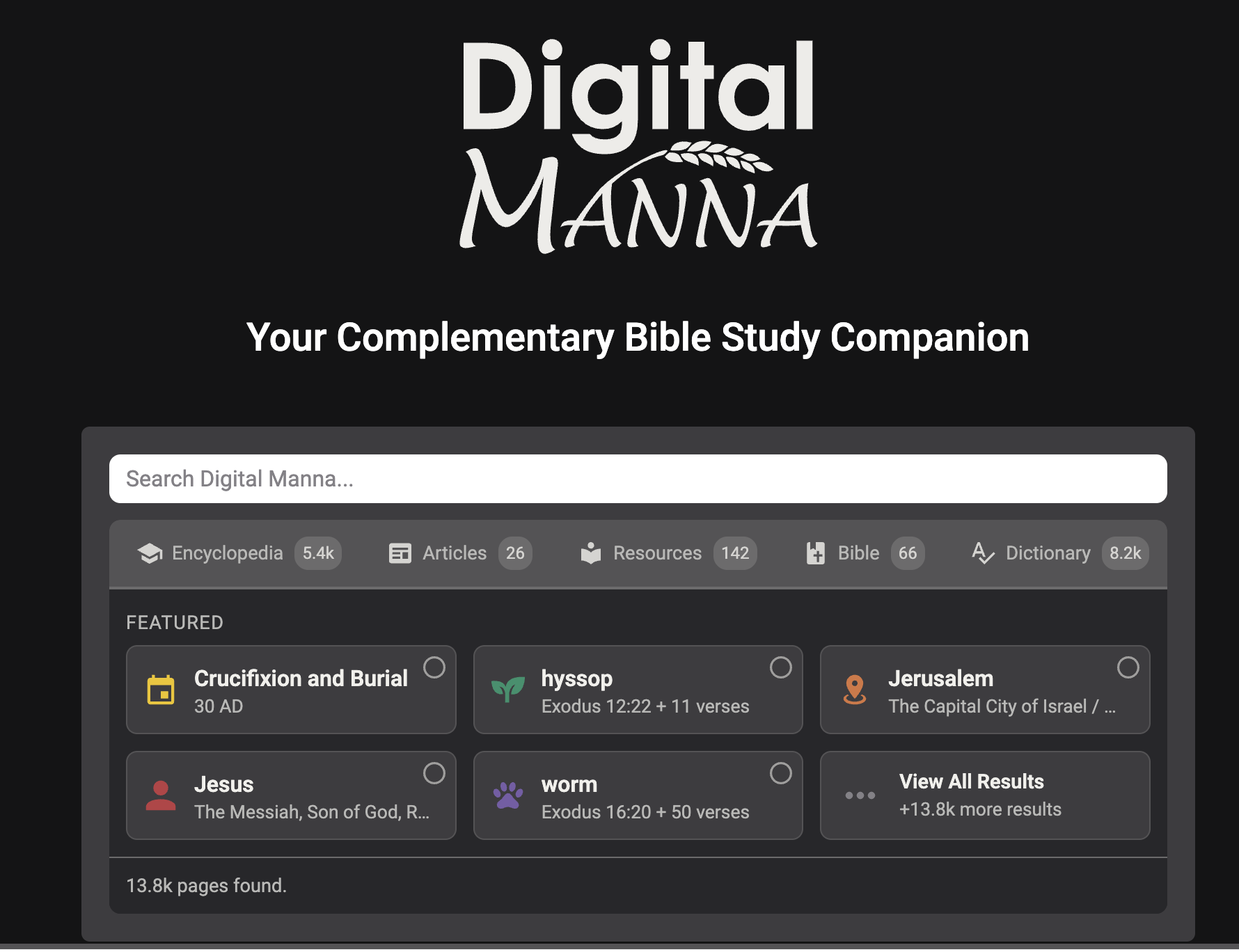
Digital Manna describes itself as a complementary Bible-study companion, drawing from carefully curated sources like Theographic, then taking that foundation further for its own study tools. It is another example of shared data being refined for a particular type of study experience.
Begat
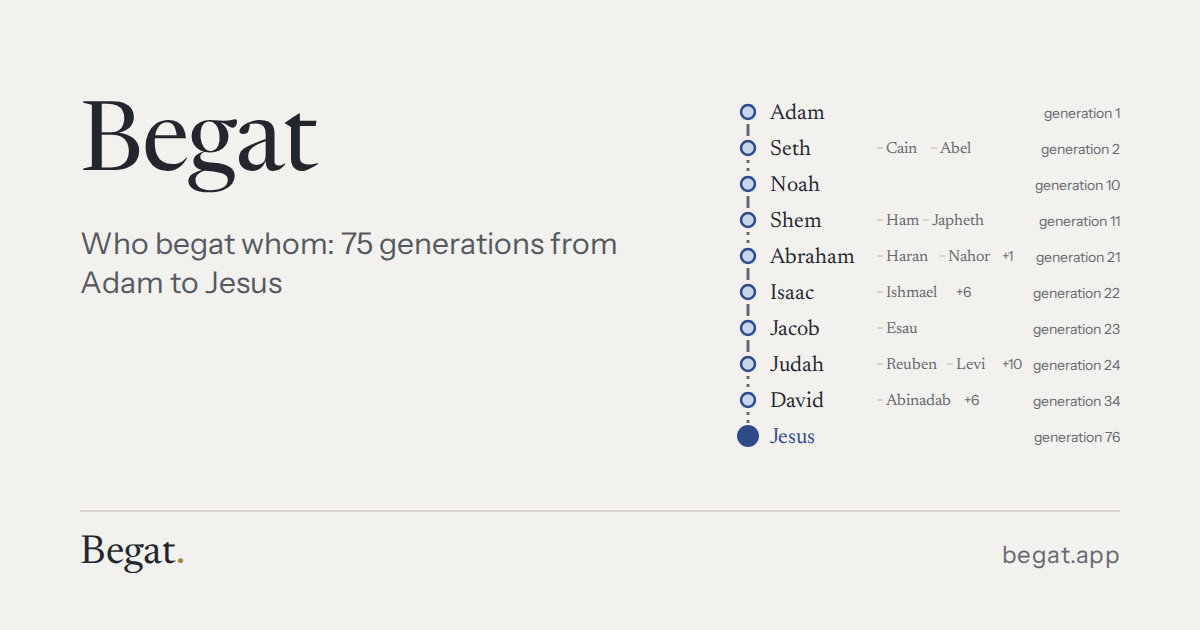
Begat connects people, places, and events through family trees, maps, timelines, and verse lists. It combines Theographic’s linked entities and chronology with geographic resources from OpenBible.info and other sources. Its explanations of the sources, methods, and changes let readers look beyond the presentation to understand how it was assembled.
It is also available on the App Store as Begat: Bible People Explorer.
Biblia Chronos
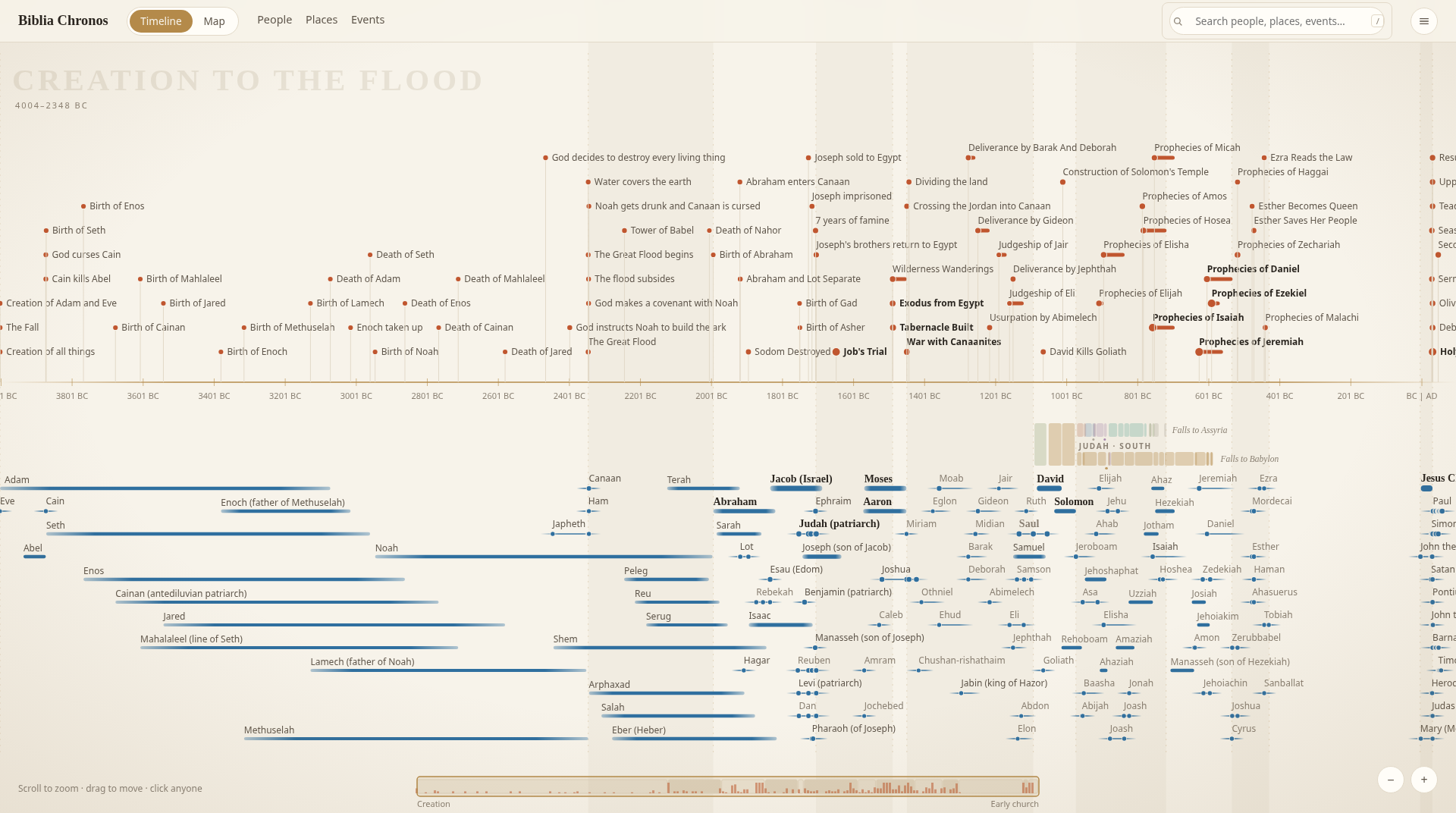
Biblia Chronos presents the story of Scripture from Creation to the early church on an interactive timeline, with a companion story map and a page for every person, place, and event. The zoomable timeline shows eras, events, and people’s lifetimes, including the kings of Israel and Judah by ruling house. It takes Theographic’s people, places, events, relationships, and chronology as its starting point, with place coordinates that come through Theographic from OpenBible.info and other geocoding, organized by eras, kingdoms, etc.
Open English Translation
The Open English Translation pairs an open-licensed translation project with linked study resources. Its public code includes an adapter for Theographic’s people, places, events, and other verse metadata, showing how these connections can support a translation-centered project as well as a standalone visualization.
Full Bible Tree
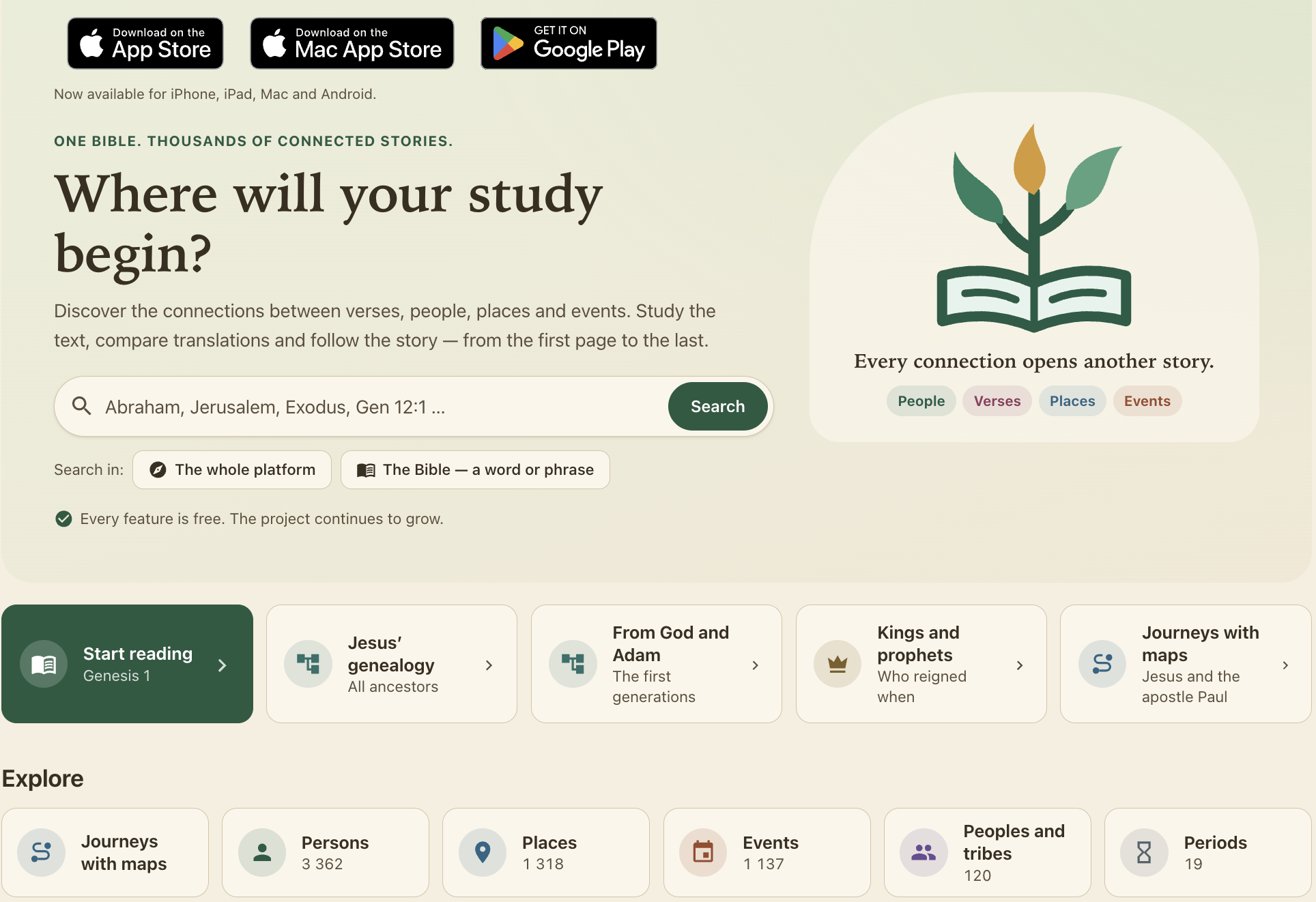
Full Bible Tree brings Bible reading together with connected people, places, events, genealogies, timelines, and multilingual reference material. Rather than treating those as separate reference tools, it lets readers explore their connections. It draws on Theographic alongside OpenBible.info, STEPBible, and other sources, bringing several strands of open Bible data into one reading experience. It is also available as a mobile app on major platforms like the Apple App Store.
BibleLine
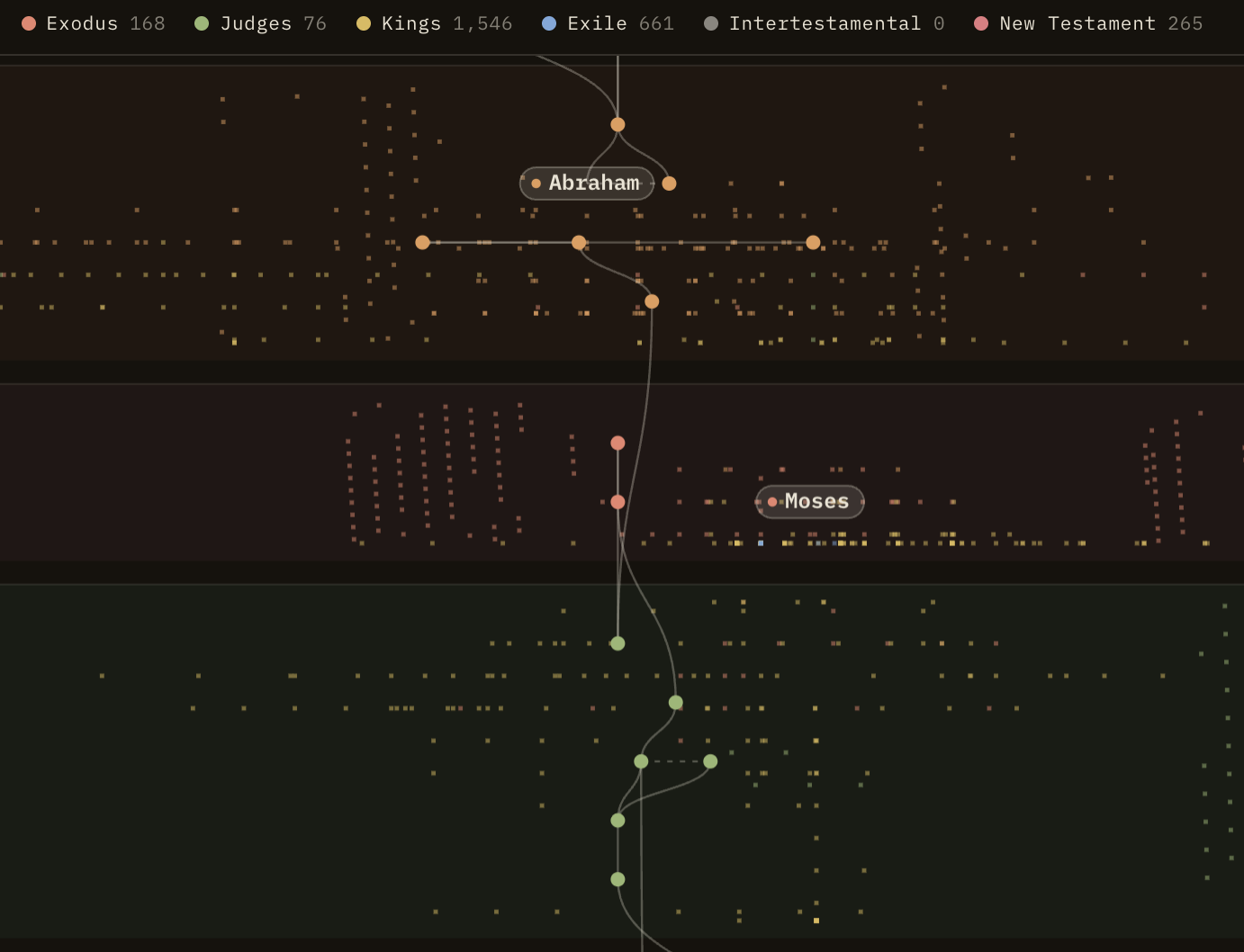
BibleLine presents the people of the Bible through a connected family tree, supported by chronology and character profiles. Its focus is the human thread through the story: who belongs to whose family and where they fit in biblical history. Its character and genealogy data draws on Theographic, alongside supplementary reference works and Bible texts.
Jonny Jackson’s Bible Family Tree
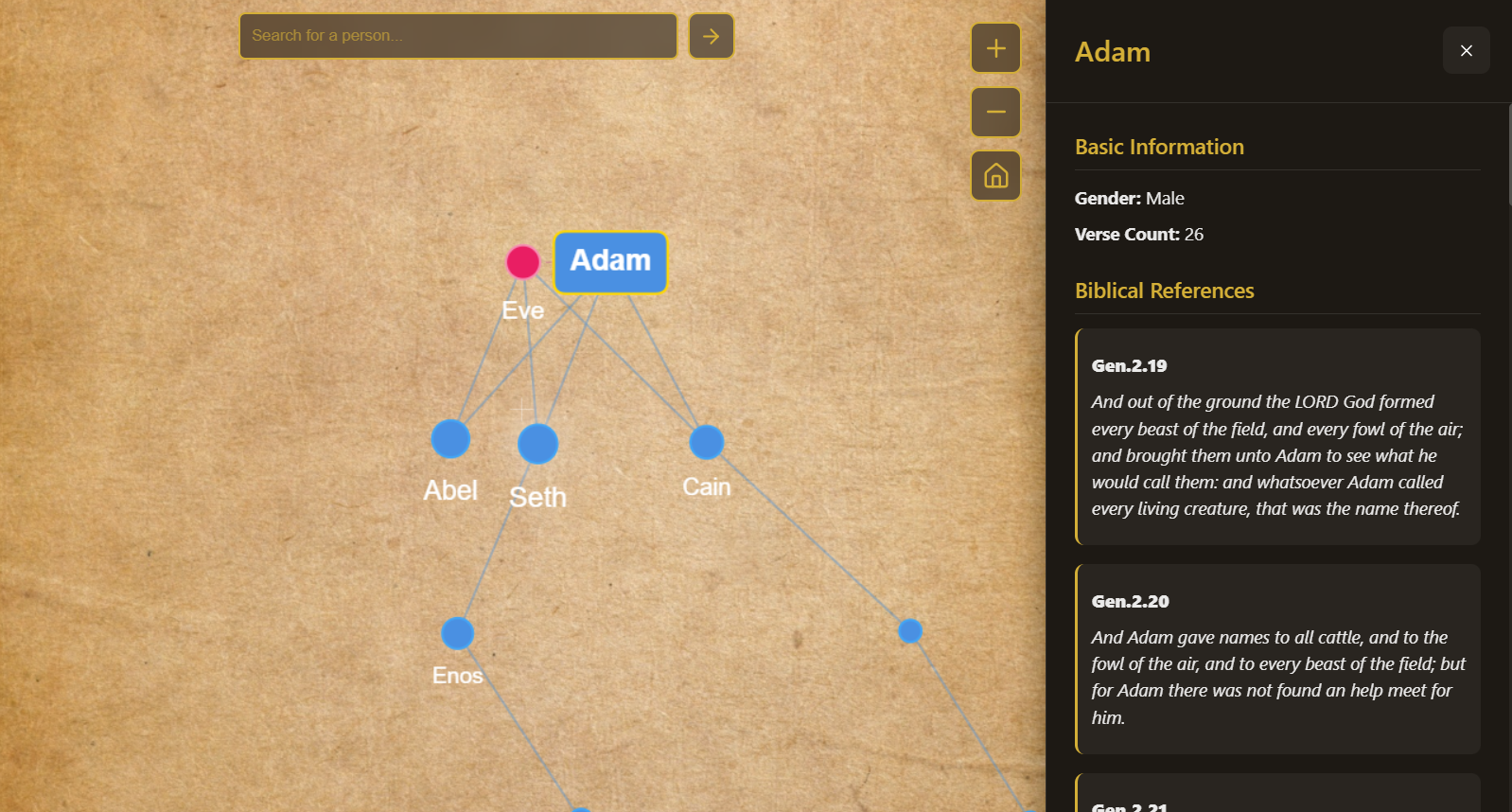
Jonny Jackson has turned family relationships into a draggable, zoomable graph stretching from Adam to Jesus. The graph makes exploring the family connections a hands-on experience rather than a matter of reading a list. The viewer adapts a December 2025 snapshot of Theographic’s family data, giving those relationships a form readers can explore directly.
RabbiRabbit
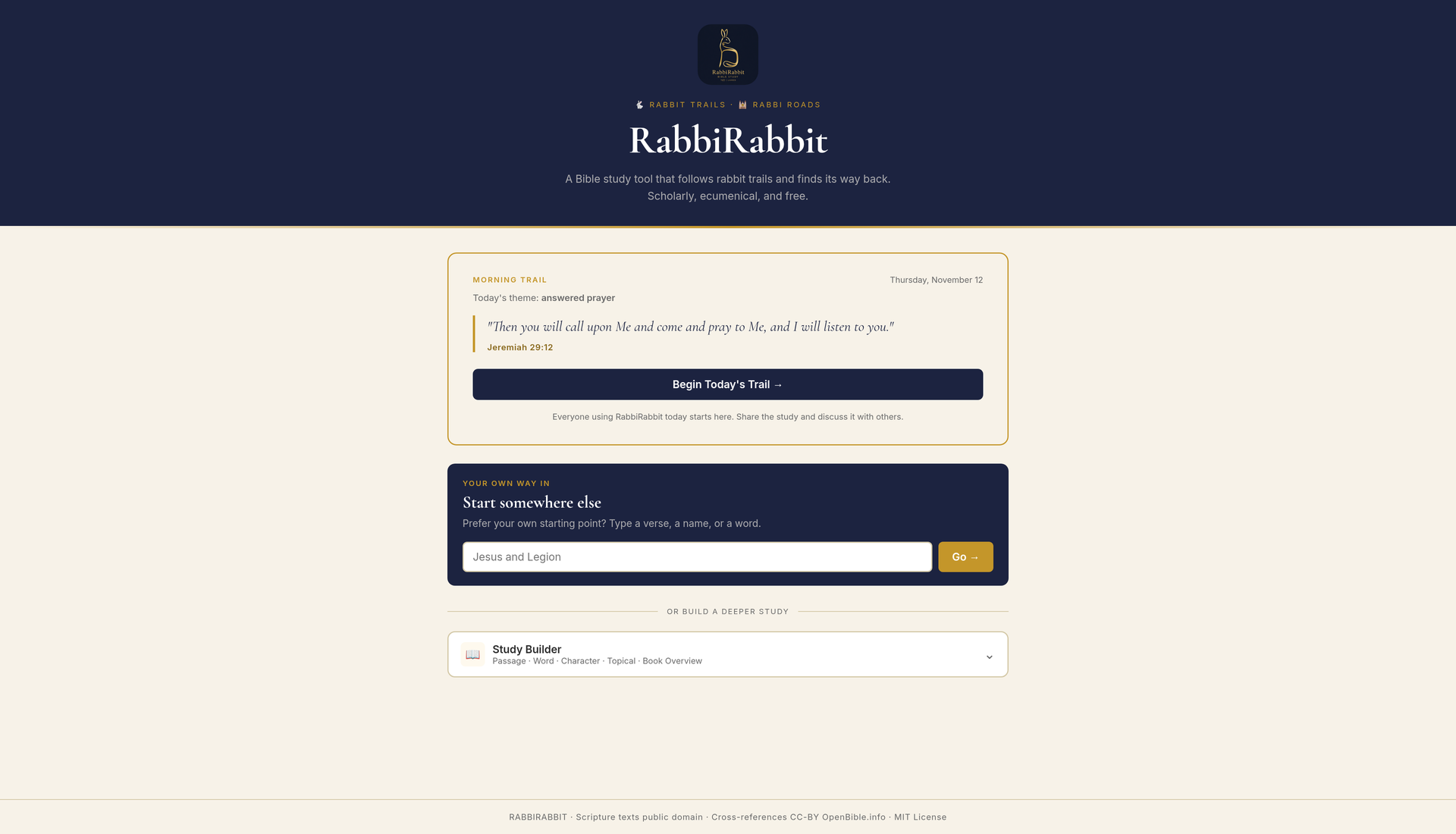
RabbiRabbit is a free, scholarly, ecumenical Bible study tool that follows “rabbit trails” through Scripture and finds its way back. It offers a shared daily seed passage and can generate passage, word, character, topical, and book-overview studies. Its on-site source list credits public-domain commentaries, church fathers, Nave’s Topical Bible, OpenBible.info topic scores and cross-references, Strong’s lexicons and concordance, and the World English Bible, Berean Study Bible, King James Version, and American Standard Version. Its public repository includes a 1,894-name character index derived from Theographic Bible Metadata, which character studies use to resolve a name to its first-appearance passage.
Both Visible and Invisible
These sites represent a slice of publicly visible things that are enabled by the data. But, there’s much more in the parts that are visible to developers and backend architectures. For example, the Free Use Bible API is celebrating more than 100 million API requests this year, a striking glimpse of how much quiet use flows through open infrastructure like AO Lab’s.
Part of its gift is gathering so much of this community’s work in one place. It describes itself as “an easy-to-use and fully featured JSON API for Scripture”: 1,256 translations across 1,004 languages, Bible audio, classic commentaries, and Bible data sets including OpenBible.info cross-references, STEPBible lexicons, History Globe, and Theographic. There’s no API key, nothing to sign up for, no usage limits, and it’s free forever. Its hope is one we share: “Together we can build an open ecosystem for global Christianity.” As their own site puts it, “What one of us builds, all of us should be able to use.”
Theographic stats give us some idea of how many are using it: as of November 7, 2026, its GitHub repository has 92 forks, and the data request log holds 1,032 entries from September 2018 through October 2026. The existing categories put 601 requests (58%) under Bible Study, 154 under Developer, and 116 under Dataviz. 59 descriptions mention AI, machine learning, or related language tools; others describe teaching, church life, and academic work. These figures describe requests for Theographic, not the whole community, unique people, or completed projects. Across our projects, much of the work may remain in research, personal study, or private tools. Not every apple becomes a website.
The Weight of Getting It Right
These projects reflect their builders’ choices and interpretations. Sharing data does not mean I built, endorse, or have checked everything they contain. But that has always been the nature of fruit. My part is to keep tending the branches and to offer the best, ripest fruit I can, as faithfully and carefully as I’m able.
Working from shared sources also means sharing responsibility for their care. A correction can help more than one project; a mistake can travel just as far. When we reuse a record, we may also carry its errors into the next dataset, map, or study tool.
One example is a small southern border town in Joshua 15 that ended up with the coordinates of the famous northern city of Hazor. The same coordinates appeared in other datasets too. A seemingly minor mix-up can leave readers looking at the wrong end of the map.
I’m committed to checking Theographic carefully. I’m using AI as a kind of superhuman researcher, scouring archives, dictionaries, and commentaries and comparing sources against each other and against Scripture, with every change still reviewed by a person.
That effort now has a public home. Every known problem, whoever finds it, goes into a data-quality ledger kept in the repository alongside the data. Each entry records the evidence and a check that confirms the fix once it lands. A corrections log then summarizes what changed in plain words, export by export. Some fixes are small but telling. Jacob’s lifetime had borrowed his father Isaac’s 180 years instead of his own 147. Isaac’s death was listed as its own predecessor, so it followed nothing at all. The Mount of Olives was split across three separate place records. Because the ledger is versioned with the data, anyone who builds on a particular release can see exactly which problems were known at that point, and whether they’ve since been fixed.
I’d rather show my mistakes than hide them. Corrections made in the open can flow downstream to every project that shares the data. If you spot something wrong while building or studying, please report it, and it will be tracked in the ledger until it’s resolved. None of us can promise flawless data, but we can help one another improve it.
The Next Innovations
Seeing what others have built also sharpens my sense of what I still hope to explore. When I began compiling this post, I had not yet found the combination I’m looking for: a comprehensive view of biblical history with an interface that handles complexity without becoming complicated to use. Then, I was introduced to Biblia Chronos, which hit that sweet spot.
I also have my own ideas for timeline visualization exploration and may soon share that with the world. Even if that doesn’t happen, I’m encouraged by the number of people with great ideas and the pace of innovation enabled by today’s AI agents.
In Proverbs, Wisdom sets her table and calls out, “Come, eat my bread and drink the wine I have mixed” (Proverbs 9:5, Berean Standard Bible, on Seed Bible). That invitation is Wisdom’s, not mine, but it shapes how I hope this fruit is received. So come, take it, and build whatever God puts on your heart, but use it wisely, with care for the truth of the text it serves. I’ll keep growing more.